 Yup, it's a cattle underpass, right here in Shelton. Who knew. It's at Nicholdale Farm (Shelton Land Trust property), immediately west of the main parking lot. The tunnel was incorporated into the construction of Route 110 so cattle could cross the road. There are no longer any cattle, but maybe some wild animals use it (they actually build tunnels for amphibians to cross roads these days).
Monday, November 26, 2007
Cattle Underpass
Yup, it's a cattle underpass, right here in Shelton. Who knew. It's at Nicholdale Farm (Shelton Land Trust property), immediately west of the main parking lot. The tunnel was incorporated into the construction of Route 110 so cattle could cross the road. There are no longer any cattle, but maybe some wild animals use it (they actually build tunnels for amphibians to cross roads these days).Sunday, November 25, 2007
Tamarack

Tamarack (aka larch) look like a spruce or pine, but their needles turn color each year and fall, just like the maples and oaks. It's when they change color that they really stand out. I normally associate them with northern bogs and streams, but here's a line of tamarack growing in the Shelton Land Trust's Nicholdale Farm off Route 110 in the White Hills. I also noticed a tamarack changing color on Bridgeport Ave near exit 13 the same week.
Tuesday, November 6, 2007
Salamanders


Mike VanValen sent me these pictures he recently took of salamanders along the trails in Shelton. The salamander at left was identified as "Leadback" Salamander (Plethodon cinereus). He also took great photos of Northern Two-Lined Salamander (Eurycea bislineata) and Northern Dusky Salamander (Desmognathus fuscus). Click here to see the photos.

Wednesday, October 3, 2007
Barred Owl
A Barred Owl has been hooting away all summer north of our house, near the southern end of the Shelton Lakes Greenway, around Buddington Road and Great Oak Circle. Instead of the steady "hoo, hoo" of the Great Horned Owl, which I used to hear on occasion, I now hear a hooting that has a weird trailing off on the last note. It's commonly described as "Who cooks for you? Who cooks for you ALL?" The "All" note sounds oddly like an elephant.
Here's a sound file. Barred Owls and Great Horned Owls apparently don't mix very well, so their territories tend not to overlap much. That would explain why I don't hear the Great Horned Owls this summer now that I'm hearing the Barred Owl.
Here's a sound file. Barred Owls and Great Horned Owls apparently don't mix very well, so their territories tend not to overlap much. That would explain why I don't hear the Great Horned Owls this summer now that I'm hearing the Barred Owl.
Monday, October 1, 2007
Water Quality Sampling
 Over the past few years the Housatonic Valley Association (HVA) has sponsored macroinvertebrate sampling of several Housatonic River tributaries, including the Far Mill River and Indian Hole Brook in Shelton. Last weekend, myself and a few other volunteers scrubbed little bugs off of the rocks in the river for hours, which were carried by the current into our nets. Later, we picked out every bug (macroinvertebrate) we could find from the samples, placing them in ice cube trays (photos), and identified them. It's very time consuming, about 3-4 hours per sampling location, and it usually takes two people.
The type of macroinvertebrates you find says a lot about the water quality. Certain types, like stoneflies, must have very high oxygen levels at all times. Other types, like blackfly and midge larvae, can live with very little oxygen and high numbers may be found in polluted waters (including my goldfish pond).
Because we volunteers are no experts, we pick one of every type of bug we find and place it in a jar of alcohol. HVA submits the jars to the DEP, who re-identifies everything in the jar and publishes a report. Here's the 2006 report.
The good news is that both streams are oxygenated enough to support a small number of sensitive species such as common stonefly larvae. The many waterfalls and riffles of both rivers is a big factor there. The bad news is that we are not usually finding many of the most sensitive species. Most of the bugs we do find -- netspinner caddisfly, fingernet caddisfly, midge and blackfly larvae -- are indicative of unnaturally high organic loads. Think lawn fertilizer and lawn clippings getting washed into the storm sewer.


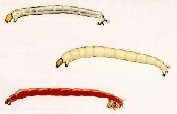

For example, near Mill Street (Gristmill Trail), we collected 5 stoneflies (good), and also about 200 netspinners, 35 fingernet caddisflies, 1 fishfly, 2 snails, 3 riffle beatles and one small minnow mayfly. These are the bugs in the ice cube trays in the picture up above (click it to enlarge). Other Far Mill River samples were taken near Route 110 and off of Roaring Brook Lane. The sample near Route 110 looked better this year than the samples we usually get.
Here's a video from last year showing how we sample the river. Sometimes we get unexpected animals. The first year we caught a baby eel. This year we caught a baby salamander and a couple of fish (blacknose dace and tesselated darter).
Update 10/9/2007: A sample collected from Means Brook at Lane Street had none of the "most wanted" species, which suggests that oxygen levels are too low to support sensitive species.

Friday, September 28, 2007
New Open Space Website
Where have I been lately? Well, for one thing, I've been working on a new website for the City's open space properties, online at http://sheltonopenspace.googlepages.com/home. It's just a start!
Thursday, July 26, 2007
Cannibal Frog
Yesterday I assumed the ruckus in my pond was another frog fight until I discovered our largest pond frog, "Bubba", with a pair of frog legs jutting from his mouth. According to Wikipedia, Green Frogs will "consume anything that can fit in its mouth, such as: crickets, flies, fish, crayfish, shrimp, grasshoppers, smaller frogs, tadpoles, small snakes, birds, mollusks, moths, and their own cast skin." I managed to grab my camera and get him on film just as he swallowed the feet (see below). Update August 14: Bubba was recently seen eating one of my goldfish, the tail hanging out of his mouth. This frog will eat anything that moves. Update October 2007, I've been told this one is a Bull Frog because it doesn't have ridges (see comments). If she's eating the Green Frogs, does that mean she's not a cannibal?
Green Frogs (Rana clamitans) are the classic pond frog in Shelton. Build a pond in your yard, and they will come in no time at all, adding a rather silly sort of charm to the pond. The males will puff out their yellow throats and starting singing only a few feet away from you, and they'll get into crazy frog fights. If you startle them, they yelp while making a comical leap.
Because most animals find their taste repulsive and do not eat them, the frogs are incredibly tame (my children have even managed to pet them on occasion). Dogs vomit after picking them up. Even the tadpoles taste bad. A few years ago I drained the level of my pond overnight to 6", with catastrophic consequences. By the next morning, the raccoons had reduced my goldfish and koi to nothing but a few scales. But the ground was littered with dead Green Frog tadpoles, each one having been tasted and then tossed aside.
They get so big that people often mistake them for bullfrogs. I frequently see them in our lakes, rivers, and puddles. The tadpole are also huge - several inches long, and they take over a year to mature.
Thursday, July 5, 2007
Thems Good Eatin'

 Mmmmm.......
We've got raspberries, highbush blueberries, huckleberries on the way (all along the powerlines).
Hey, what's the deer doing there? Well, they can be tasty, too, especially with a side of onions, but I'm afraid they're too cute to harvest (unless they eat the flowers in my garden) and besides, it would be against state regulations.

Tuesday, July 3, 2007
Housatonic Coyotes
 I received this intriguing set of photos taken by a boater on the Housatonic from Leon Sylvester Jr. The story passed on to me was that of a mother fox and her cubs hanging out by the river edge (first photo). The boater could see a coyote stalking her, and threw something in its direction to alert the fox, who immediately defended her kits from the intruder.
I suspect the "fox" may actually be another coyote. Fox are about 12 pounds, while coyote are closer to 30 lbs, so there is a big size difference. 
Giant Leopard Moth

 While searching a stone wall for a hidden geocache box off of Turkey Trot Trail, my son discovered the above Giant Leopard Moth, which has a wingspan of 3". Teenagers are not easily impressed by bugs, but this one was striking.
A few years ago I ran across the larvae of this species - a huge wooly caterpillar off of Dominick Trail with distinctive red spots. It was so unusual I took it home to identify it.
Thursday, June 21, 2007
Shelton Family Farm

Shelton Family Farm is off-limits to the general public, but since the the City of Shelton purchased the development rights in 2004 with the help of a USDA grant, we are required to inspect it each year. I had the pleasure of making that inspection today - what a beautiful piece of land!
The farm is located along the south side of Leavenworth Road (Rt 110) between the Monroe town line and Walnut Tree Hill Road, next to Jones Family Farm.

The farm is located along the south side of Leavenworth Road (Rt 110) between the Monroe town line and Walnut Tree Hill Road, next to Jones Family Farm.


 Part of the farm is leased by the Jones Family and planted with Christmas Trees, so you may have been on it if you cut your own trees at the Jones Farm.
 There's a little pond called Lake Emerson formed by the damming of Nelson Brook. You can see if from Rt 110. I saw a couple of nice trout in the brook (see photo).
There is also a speedway, but that area isn't covered under the easement.

Sunday, June 10, 2007
Weird Week of Animals
 During the past week, I caught a wolf spider inside my washing machine, found a cute little ring-necked snake under a rock by the back door, and had to fish out a big snapping turtle from my goldfish pond. See my photos.
It started on Monday when I absent-mindedly stuck my hand in the washing machine to grab the wet clothes and instead nearly grabbed a huge, hairy spider guarding the clean socks. I'd left the top to the machine open and he must have wandered in. After letting out a horrendous, involuntary shreak, I grabbed a jar and captured him. According to several sites on the web, wolf spiders make good pets (the Ansonia Nature Center has one). They can live for three years, and do not make webs. You just throw bugs in the container for them to eat. 

As I was looking under rocks to find some insect meals for the spider, I found a small ring-necked snake all curled up. I don't remember ever seeing one of these snakes, which are shyer than garter snakes and therefore more difficult to see, but eat the same things: small salamanders and the like.
Finally, as I went out to feed my goldfish I was stunned to find a big snapping turtle hanging out in my pond lily. How dare he! Well, those goldfish are probably pretty easy to pick off. This is a 1200 gallon pond with murky water and plenty of potted plants and rocks and it was hard to get him out. I had to take all the plant out and start pumping out the water. After I stood over the pond holding a net for a very long time, the turtle finally floated very slowly near the surface and I quickly nabbed him with a net. He proceded to eat the net and hiss at me. Cute face, though. I took him on a little trip and let him go at Silent Waters, where a few years ago the pond level was raised substantially and the fish are probably  flourishing.
 flourishing.
 Wednesday, June 6, 2007
Red-Tailed Hawk Nest
 I don't think I've ever been scolded at so much as when I stumbled upon an active red-tailed hawk nest on City open space on Huntington Street near Trap Falls Reservoir and Commerce Drive. I was on the property for almost two hours, and eventually I could tell where I was just by the sound of the screaming hawk. I never got a clear view of the birds, just glimpses, but that's pretty normal for wildlife viewing in the summer. I could only identify the hawk by the call. What caught my ear, though, was a whistling that I did not recognize and assume was either the mother hawk or her nestlings (see the video to hear it as well as me being scolded). Coordinates of the nest are N41° 16.7673', W73° 8.3946'. Watch out if you're standing below or you may receive a white gooey gift from the birds! I also witnessed a big fight between a blue jay and a squirrel (the blue jay won); the squirrel was probably trying to steal the jay's eggs (squirrels do eat bird eggs).
Saturday, May 26, 2007
Biggest Mushrooms I Ever Saw
Check out these monster mushrooms growing on the Rec Path near Meadow Street in woodchips.  Apparently conditions have been ideal for the mushrooms there because there are several different types, one quite pretty (see photos). I also took photos of pink lady slippers in bloom next to Hope Lake, near the point where Oak Valley and Dominick Trails meet. They bloom in that spot each year in May and are usually still in bloom about the time of Trails Day (first Saturday in June). Also took pictures of some Wisteria in bloom along Shelton Ave where the Rec Path crosses the road. It looks like the Chinese Wisteria, which is an invasive species. A pretty one, though.
 Apparently conditions have been ideal for the mushrooms there because there are several different types, one quite pretty (see photos). I also took photos of pink lady slippers in bloom next to Hope Lake, near the point where Oak Valley and Dominick Trails meet. They bloom in that spot each year in May and are usually still in bloom about the time of Trails Day (first Saturday in June). Also took pictures of some Wisteria in bloom along Shelton Ave where the Rec Path crosses the road. It looks like the Chinese Wisteria, which is an invasive species. A pretty one, though.
Sunday, May 20, 2007
Shelton Beaver Mystery
 Article in the Post today says that beaver have come back to Shelton and are living south of Lane Street on Means Brook. I'm not so sure. They WERE living there, but back in February I walked out on the ice and discovered their dam was blown out, and they haven't repaired it. The lodge (see photo) was located upriver about 75 feet. Usually beaver will repair a dam within a day or two. I also haven't seen any new beaver sign lately, like freshly cut trees. People have said they've seen the beaver swimming, but I've seen muskrat swimming, and many people confuse the two.
The beaver utilized a substantial causeway that crosses the wide Means Brook swamp behind Huntington Street. The causeway has a 10 ft gap which the river flows through (it's a good 5 feet deep), and there was once a bridge over the gap that has washed out. The vast majority of the "beaver dam" was actually this causeway. The causeway is accessible from the Rec Path at a sharp bend in the Land Trust meadow off of Lane Street (look into the woods a bit and you will see beaver-cut trees). The causeway is normally overgrown with vegetation and parts are wet, which why winter is the best time to check it out. Here's a video of the causeway where the beaver were, clearly showing they are gone.
Silent Waters Mystery Piers

For years many volunteers have pondered the row of paired stone & concrete supports located along the base of the Silent Waters dam (see photo). What were they? The dam was built in the late 1800's and burst in 1903, never to be repaired, so the supports were probably from the late 1800's as well. Mike Picone of Aquarion took a look at the pillars for me and stated what should have been obvious to us all: The piers held up a really big pipe associated with the reservoir. Of course! Reservoirs were (and still are) used for drinking water and there is an entire infrastructure related to transferring the water from the reservoir to the public.
I also took some photos today of yellow rocket and white baneberry in bloom at the base of the dam, and some views of Silent Waters on the new path at the top of the dam (see photos).
Friday, May 18, 2007
Gristmill Trail After Flood
 After my husband called to tell me he found a tiny snapping turtle, about the size of a half-dollar, on Gristmill Trail, I decided to take a quick spin down the trail. Wow, the April 15 flood really ripped it up! This trail floods regularly -- it's in a floodplain, after all -- but this was different. The 2nd bridge was dislodged (the first one we gave up on a few years back because we kept losing it), and the trail erosion was pretty deep, exposing lots of roots. In other place, sand was dumped on the trail.
I took photos of several types of our most impressive ferns: Cinnamon, interrupted and royal ferns; also spring wildflowers including wild geranium (my favorite), Jack-in-the-pulpit, and Canada Mayflower. No turtle nest, however! Snapping turtle eggs normally hatch in the fall, but may over-winter and hatch in the spring, and females may lay eggs up to 10 miles away, which sounds a tad ridiculous to me.
Sunday, May 6, 2007
Letterboxing at Wolfe park
 I took my daughter letterboxing at Wolfe Park in Monroe this afternoon, and we found all 8 boxes for the "Hey Jude" series (see letterboxing.org for clues and general info about letterboxing). Many of the boxes were a bit tricky and also full of water, but all the hand-carved stamps were good and pertained to Beatles songs. We capped off our outing with ice cream from the snack bar at Great Hollow Lake.
En route, we saw plenty of spring wildflowers, including red trillium, spring beauties (photo), and woodland anemones. And as we sat on one of the many benches along our hike we also got a good look at a pair of spotted sandpipers hunting along the shores of the stream that flows out of the lake. See photos.
Saturday, May 5, 2007
Newts Stalking Their Prey
.jpg) There is a skeegy little pond next to Nells Rock Trail under the power lines - you can't miss it - which is full of little red-spotted newts quietly stalking their prey, which happily consists primarily of mosquito larvae. There is a big piece of ledge that rises nearly ten feet above the pond about 30 feet off of the trail. Sit on it, with your feet dangling over the edge, and enjoy a little break from your hike. If you watch very, very carefully, you might see some of the salamanders as they slowly stalk over and under the mass of vegetation. Think of it as an "I spy" game. See photos.
There is a skeegy little pond next to Nells Rock Trail under the power lines - you can't miss it - which is full of little red-spotted newts quietly stalking their prey, which happily consists primarily of mosquito larvae. There is a big piece of ledge that rises nearly ten feet above the pond about 30 feet off of the trail. Sit on it, with your feet dangling over the edge, and enjoy a little break from your hike. If you watch very, very carefully, you might see some of the salamanders as they slowly stalk over and under the mass of vegetation. Think of it as an "I spy" game. See photos. Oddly, red-spotted newts have two forms, the aquatic one (shown) and the bright red terrestrial form called the red eft. They start out as the aquatic form as babies, then switch to the red terrestrial form for a few years as adolescents, so to speak, then revert to the original form as full adults. I was watching the adults.
I once hatched salamander eggs and the baby salamanders voraciously ate mosquito larvae, which we had to raise in a little pool out back. The salamanders creep up very slowly, and as soon as one of the mosquito larvae wiggle in their face WACK - no more mosquito. A salamander can probably eat hundreds of larvae each day. While you're sitting there, tadpoles or maybe salamanders will suddenly lunge to the surface to gulp some air. You never get to actually see them, just the disruption they make at the surface.
I also got a photo of a rufous-sided towhee, which are common along the powerlines.
Sunday, April 29, 2007
Birchbank Mountain OS94

"Birchbank Mountain" is what they call the steep riverbank north of Indian Well State Park. Responding to complaints about ATVs and paintball, I visited the open space, which is a big piece of land, and sure enough, I was greeted by a group of kids on dirt bikes and ATVs. Later on I blundered into the middle of an "airsoft" game, which is similar to paintball except they shoot plastic BBs.
As far as Shelton goes, the habitat along the riverbottom is unique to the Housatonic River. The typical Connecticut oak forest is replaced by a cool, moist floodplain forest, and it was just covered with wildflowers, especially Dutchman's Breeches (thousands) and trillium. You just don't see that anywhere else in Shelton.
At the bottom of the hill are a series of ponds on water company land, which is not posted. I got a great look at a pair of wood ducks, spectacular little ducks which nest in tree cavities and are rather elusive.
Upper White Hills Brook falls rapidly down the steep slope in a series of falls. Near the brook, just uphill from the Blue Dot trail, there is a big old chimney. I been told this may be part of the Monroe Gun Club meetinghouse that burned down in the 1960's.
There are miles of illegal ATV trails on the property, but a couple of the trails are actually old colonial roads. The roadway along the bottom of the hill is called "Old Farm Road". You can see the beginning of the road from Indian Well Road, right where it crosses the RR tracks. Park there for good access to the open space. There was also a road that went up the slope to the White Hills, where presumably farmers grew produce and traveled the road down to the river, where they could ship their produce downriver. I'll be adding some "historic trail" plaques to these trails.
The park is getting some new signage and enforcement action to cut down on the ATVs and paintball games. What it really needs are some local volunteer landkeepers with cameras to walk the area routinely and take pictures of any harmful activities.
Friday, April 27, 2007
Run, Little Fox, Run!
While speaking with a neighbor of some open space off of Little Fox Run, a red fox went shooting by through the fog. It didn't make a sound and just seemed to float by. The neighbor showed me the den where the fox has been raising kits for the last few years. I guess somebody got that road name right!
Monday, April 23, 2007
Dominick Trail Treefrog

I practically tripped over a gray treefrog this evening as I was walking along Dominick Trail near John Dominick Drive. See video and pictures. I see a lot of other kinds of frogs, but not usually this species. They are a true treefrog, and their little suction cups feel weird on your fingers when you pick the frog up.
When I first got to the trail (I started on Oak Valley Road) I was greeted by a kid racing up and down Oak Valley Road on a dirt bike, who I saw going into house #6. The road goes right through the middle of the park and the entire evening was shattered for all the hikers and fishermen around the reservoir on Nell's Rock Road. Nice.
There were also the annual eggs at "J" Pond, which are easy to see from the little foot bridge south of Oak Valley.
Monday, April 16, 2007
Nor'easter of April 15
Eight inches of rain in Shelton on Tax Day! Here's some video of the Far Mill River and Means Brook flooding over the Rec Path and Gristmill Trail, plus the falls at Mill Street. The Rec Path boardwalk off of Lane was under at least a foot of water.
Saturday, April 14, 2007
Wiacek Farm

The Wiacek Farm north of the High School is a beautiful series of meadows open to the public, although few people seem to realize it. We planning on routing the Paugussett Trail extension through the farm so the Blue Dot can get from Indian Well to Shelton Lakes, so I spent Sunday afternoon walking around the farm, looking for a dry route for the new trail (didn't find one). I did find an big old farm dump with all kinds of junk (rabbit hutch, cap to a truck, old equipment) as well as a couple cow skeletons and an old enamal teapot that I took home for a flowerpot. I also saw a woodcock out in the meadow near Mayflower Lane, deer, and turkey. Woodcocks are unusual birds with really long beaks they use for getting worms out of mud - they look more like a shore bird. The Wiacek meadows are perfect habitat for them. See photos.