A Barred Owl has been hooting away all summer north of our house, near the southern end of the Shelton Lakes Greenway, around Buddington Road and Great Oak Circle. Instead of the steady "hoo, hoo" of the Great Horned Owl, which I used to hear on occasion, I now hear a hooting that has a weird trailing off on the last note. It's commonly described as "Who cooks for you? Who cooks for you ALL?" The "All" note sounds oddly like an elephant.
Here's a sound file. Barred Owls and Great Horned Owls apparently don't mix very well, so their territories tend not to overlap much. That would explain why I don't hear the Great Horned Owls this summer now that I'm hearing the Barred Owl.
Wednesday, October 3, 2007


Monday, October 1, 2007
Water Quality Sampling
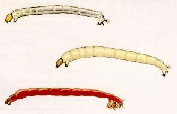
 Over the past few years the Housatonic Valley Association (HVA) has sponsored macroinvertebrate sampling of several Housatonic River tributaries, including the Far Mill River and Indian Hole Brook in Shelton. Last weekend, myself and a few other volunteers scrubbed little bugs off of the rocks in the river for hours, which were carried by the current into our nets. Later, we picked out every bug (macroinvertebrate) we could find from the samples, placing them in ice cube trays (photos), and identified them. It's very time consuming, about 3-4 hours per sampling location, and it usually takes two people.
The type of macroinvertebrates you find says a lot about the water quality. Certain types, like stoneflies, must have very high oxygen levels at all times. Other types, like blackfly and midge larvae, can live with very little oxygen and high numbers may be found in polluted waters (including my goldfish pond).
Because we volunteers are no experts, we pick one of every type of bug we find and place it in a jar of alcohol. HVA submits the jars to the DEP, who re-identifies everything in the jar and publishes a report. Here's the 2006 report.
The good news is that both streams are oxygenated enough to support a small number of sensitive species such as common stonefly larvae. The many waterfalls and riffles of both rivers is a big factor there. The bad news is that we are not usually finding many of the most sensitive species. Most of the bugs we do find -- netspinner caddisfly, fingernet caddisfly, midge and blackfly larvae -- are indicative of unnaturally high organic loads. Think lawn fertilizer and lawn clippings getting washed into the storm sewer.
For example, near Mill Street (Gristmill Trail), we collected 5 stoneflies (good), and also about 200 netspinners, 35 fingernet caddisflies, 1 fishfly, 2 snails, 3 riffle beatles and one small minnow mayfly. These are the bugs in the ice cube trays in the picture up above (click it to enlarge). Other Far Mill River samples were taken near Route 110 and off of Roaring Brook Lane. The sample near Route 110 looked better this year than the samples we usually get.
Here's a video from last year showing how we sample the river. Sometimes we get unexpected animals. The first year we caught a baby eel. This year we caught a baby salamander and a couple of fish (blacknose dace and tesselated darter).
Update 10/9/2007: A sample collected from Means Brook at Lane Street had none of the "most wanted" species, which suggests that oxygen levels are too low to support sensitive species.
Friday, September 28, 2007
New Open Space Website
Where have I been lately? Well, for one thing, I've been working on a new website for the City's open space properties, online at http://sheltonopenspace.googlepages.com/home. It's just a start!
Thursday, July 26, 2007
Cannibal Frog
Yesterday I assumed the ruckus in my pond was another frog fight until I discovered our largest pond frog, "Bubba", with a pair of frog legs jutting from his mouth. According to Wikipedia, Green Frogs will "consume anything that can fit in its mouth, such as: crickets, flies, fish, crayfish, shrimp, grasshoppers, smaller frogs, tadpoles, small snakes, birds, mollusks, moths, and their own cast skin." I managed to grab my camera and get him on film just as he swallowed the feet (see below). Update August 14: Bubba was recently seen eating one of my goldfish, the tail hanging out of his mouth. This frog will eat anything that moves. Update October 2007, I've been told this one is a Bull Frog because it doesn't have ridges (see comments). If she's eating the Green Frogs, does that mean she's not a cannibal?
Green Frogs (Rana clamitans) are the classic pond frog in Shelton. Build a pond in your yard, and they will come in no time at all, adding a rather silly sort of charm to the pond. The males will puff out their yellow throats and starting singing only a few feet away from you, and they'll get into crazy frog fights. If you startle them, they yelp while making a comical leap.
Because most animals find their taste repulsive and do not eat them, the frogs are incredibly tame (my children have even managed to pet them on occasion). Dogs vomit after picking them up. Even the tadpoles taste bad. A few years ago I drained the level of my pond overnight to 6", with catastrophic consequences. By the next morning, the raccoons had reduced my goldfish and koi to nothing but a few scales. But the ground was littered with dead Green Frog tadpoles, each one having been tasted and then tossed aside.
They get so big that people often mistake them for bullfrogs. I frequently see them in our lakes, rivers, and puddles. The tadpole are also huge - several inches long, and they take over a year to mature.
Thursday, July 5, 2007
Thems Good Eatin'

 Mmmmm.......
We've got raspberries, highbush blueberries, huckleberries on the way (all along the powerlines).
Hey, what's the deer doing there? Well, they can be tasty, too, especially with a side of onions, but I'm afraid they're too cute to harvest (unless they eat the flowers in my garden) and besides, it would be against state regulations.

Tuesday, July 3, 2007
Housatonic Coyotes
 I received this intriguing set of photos taken by a boater on the Housatonic from Leon Sylvester Jr. The story passed on to me was that of a mother fox and her cubs hanging out by the river edge (first photo). The boater could see a coyote stalking her, and threw something in its direction to alert the fox, who immediately defended her kits from the intruder.
I suspect the "fox" may actually be another coyote. Fox are about 12 pounds, while coyote are closer to 30 lbs, so there is a big size difference. 
Giant Leopard Moth
 While searching a stone wall for a hidden geocache box off of Turkey Trot Trail, my son discovered the above Giant Leopard Moth, which has a wingspan of 3". Teenagers are not easily impressed by bugs, but this one was striking.
A few years ago I ran across the larvae of this species - a huge wooly caterpillar off of Dominick Trail with distinctive red spots. It was so unusual I took it home to identify it.
Thursday, June 21, 2007
Shelton Family Farm

Shelton Family Farm is off-limits to the general public, but since the the City of Shelton purchased the development rights in 2004 with the help of a USDA grant, we are required to inspect it each year. I had the pleasure of making that inspection today - what a beautiful piece of land!
The farm is located along the south side of Leavenworth Road (Rt 110) between the Monroe town line and Walnut Tree Hill Road, next to Jones Family Farm.
The farm is located along the south side of Leavenworth Road (Rt 110) between the Monroe town line and Walnut Tree Hill Road, next to Jones Family Farm.

 Part of the farm is leased by the Jones Family and planted with Christmas Trees, so you may have been on it if you cut your own trees at the Jones Farm.
 There's a little pond called Lake Emerson formed by the damming of Nelson Brook. You can see if from Rt 110. I saw a couple of nice trout in the brook (see photo).
There is also a speedway, but that area isn't covered under the easement.
Sunday, June 10, 2007
Weird Week of Animals
 During the past week, I caught a wolf spider inside my washing machine, found a cute little ring-necked snake under a rock by the back door, and had to fish out a big snapping turtle from my goldfish pond. See my photos.
It started on Monday when I absent-mindedly stuck my hand in the washing machine to grab the wet clothes and instead nearly grabbed a huge, hairy spider guarding the clean socks. I'd left the top to the machine open and he must have wandered in. After letting out a horrendous, involuntary shreak, I grabbed a jar and captured him. According to several sites on the web, wolf spiders make good pets (the Ansonia Nature Center has one). They can live for three years, and do not make webs. You just throw bugs in the container for them to eat. 

As I was looking under rocks to find some insect meals for the spider, I found a small ring-necked snake all curled up. I don't remember ever seeing one of these snakes, which are shyer than garter snakes and therefore more difficult to see, but eat the same things: small salamanders and the like.
Finally, as I went out to feed my goldfish I was stunned to find a big snapping turtle hanging out in my pond lily. How dare he! Well, those goldfish are probably pretty easy to pick off. This is a 1200 gallon pond with murky water and plenty of potted plants and rocks and it was hard to get him out. I had to take all the plant out and start pumping out the water. After I stood over the pond holding a net for a very long time, the turtle finally floated very slowly near the surface and I quickly nabbed him with a net. He proceded to eat the net and hiss at me. Cute face, though. I took him on a little trip and let him go at Silent Waters, where a few years ago the pond level was raised substantially and the fish are probably  flourishing.
 flourishing.
 Wednesday, June 6, 2007
Red-Tailed Hawk Nest
 I don't think I've ever been scolded at so much as when I stumbled upon an active red-tailed hawk nest on City open space on Huntington Street near Trap Falls Reservoir and Commerce Drive. I was on the property for almost two hours, and eventually I could tell where I was just by the sound of the screaming hawk. I never got a clear view of the birds, just glimpses, but that's pretty normal for wildlife viewing in the summer. I could only identify the hawk by the call. What caught my ear, though, was a whistling that I did not recognize and assume was either the mother hawk or her nestlings (see the video to hear it as well as me being scolded). Coordinates of the nest are N41° 16.7673', W73° 8.3946'. Watch out if you're standing below or you may receive a white gooey gift from the birds! I also witnessed a big fight between a blue jay and a squirrel (the blue jay won); the squirrel was probably trying to steal the jay's eggs (squirrels do eat bird eggs).
Subscribe to:
Comments (Atom)